Ready for the gigabit society
Deutsche Telekom already provides more than 90 percent of the German population with cable-free Internet access.
Across all areas of the economy and society, digital networks and higher bandwidths are becoming ever more important - whether interactive, "Full HD" television over the Internet, digital fleet management, smart electricity management or the growing use of innovative cloud-based services.
These rapid advances are being made on the back of Deutsche Telekom's reliable and ultra-modern cable, fixed and wireless networks. The goal is to grant ever more people access to the super-fast Internet, making it available to the public at large. In order to satisfy the growing demand from consumers, SMEs and large corporations alike, Deutsche Telekom is set to substantially boost its expenditure on network expansion as from 2013. At Deutsche Telekom's Capital Markets Day held December 2012, Telekom CEO René Obermann announced the company's plan to spend EUR 6 billion in the period until 2020 solely to upgrade its German network with optical fiber cabling and DSL vectoring.
Key technologies for the fixed network
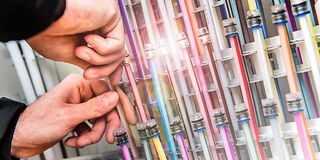
The focus of the optical fiber upgrade is on that part of the network up to the cable branch boxes, those gray curbside boxes on German streets (technicians call this process "fiber to the curb" or FTTC for short). By 2016, around 65 percent of the population will have access to FTTC. Although copper cables will still be used to handle the last "mile" from the cable branch boxes to the individual households, thanks to the new vectoring technology customers will enjoy transmission rates of up to 100 Mbit/s for downloads - twice as fast as the already super-quick VDSL.
A cutting-edge wireless experience
The thirst for data is growing in mobile applications as well. Six out of every ten Germans already have an Internet-capable cell phone (smartphone). Deutsche Telekom's 3G/UMTS and 4G/LTE networks already provide more than 90 percent of the German population with cable-free Internet access in unparalleled high quality, as tests carried out by industry publications "connect" and "CHIP online" have shown. By 2016, as many as 85 percent of Germans will be able to access LTE, benefiting from data transmission rates of up to 150 Mbit/s. Browsing speed, too, is increasing all the time: going forward, intelligent hybrid-box technology will mean that data traffic can be routed in parallel or, alternatively, via vectoring and LTE - whichever is needed. At full tilt, the system will be able to reach download speeds as high as 200 Mbit/s.
How the "gigabit society" works
With its integrated network strategy, Deutsche Telekom is paving the way toward to the Gigabit society, in which communication, data and information can be securely exchanged at ultra-high speeds between all kinds of terminals (TVs, PCs, notebooks, tablets and smartphones). Find out what that will be like here: Experience the future of communication.
Stay up-to-date
Subscribe to our media information news service and important dates of Deutsche Telekom.