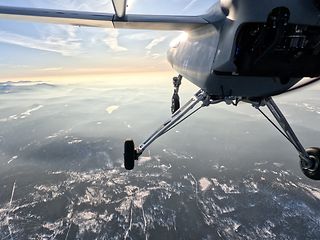
- Two aircraft successfully tested in seamless alternating operation
- Direct satellite backhaul connects the flying base station to the mobile core network
- New opportunities for resilient mobile connectivity in special operational scenarios

Deutsche Telekom has successfully demonstrated how mobile connectivity can be provided from the air without interruption. Following the first deployment of a flying base station in a commercial live network last year, the company has now reached the next development milestone. Together with T-Mobile Czech Republic and Primoco UAV, Deutsche Telekom tested the seamless alternating operation of two unmanned aerial vehicles (UAVs) as flying base stations during a large public event. The successful trial brings resilient airborne mobile connectivity one step closer to practical application.
“Innovation happens when new technologies prove themselves under real-world conditions. The insights gained from this successful trial point the way towards the next stages of development. Our goal remains resilient mobile connectivity for special operational scenarios,” says Jaroslav Holiš, Senior Manager Research & Trials at Deutsche Telekom.
Seamless handover ensures continuous mobile coverage
During the recent trial in the Czech Republic, smartphones automatically connected to the active mobile cell, allowing calls and data connections to continue without interruption.
“The key advantage of deploying two Primoco One 150 aircraft is the ability to provide continuous 24/7 service,” says Ladislav Semetkovský, CEO of Primoco UAV. “When one aircraft is on the ground for refuelling, the second remains in operation, ensuring uninterrupted connectivity. This makes the solution particularly valuable in crisis situations, where reliable communication must be available around the clock.”
Satellite backhaul expands deployment options
The trial also included satellite backhaul integrated directly into both aircraft. This enabled the UAVs to connect directly to the mobile core network without requiring an additional ground station.
When conventional infrastructure reaches its limits
Together, seamless alternating operation and satellite backhaul open up new deployment scenarios with flying base stations for temporary mobile coverage. In the future, the technology could complement terrestrial networks wherever infrastructure is unavailable or damaged, or where additional capacity is needed at short notice. Possible scenarios include wildfires, floods and large outdoor events in remote locations.
Field trial during a trail-running event
The system was tested under real-world conditions during the Běhej lesy trail-running event in the Czech Republic. The remote course in the Brdy Protected Landscape Area, where mobile coverage is limited, provided ideal conditions for the field trial. While a compact portable cell tower supplied coverage at the start and finish areas, two aircraft with integrated base stations delivered seamless coverage along the race route by alternating in operation. Around 1,900 runners remained reliably connected throughout the event. The successful handover between the two aircraft, confirmed the technical feasibility of the concept.
High-performance mobile coverage from the air
Flying at altitudes between two and three kilometres, the two flying base stations provided mobile coverage across an area of up to 20 square kilometres during the field trial. They operated on the same standard frequency bands as the terrestrial network and achieved data rates of up to 100 Mbit/s using a 10 MHz channel. Network capacity can also be prioritised when required, for example for emergency responders. The aircraft used in the trial already hold extensive European certifications.
Technology for resilient communication networks
The field trial demonstrates the potential of flying base stations for the communication networks of the future. Together with partners from industry and research, Deutsche Telekom continues to advance the development of this technology. In the future, it could complement communication networks in special operational scenarios and create new opportunities for emergency services, civil protection organisations and operators of critical infrastructure.
About Deutsche Telekom: Deutsche Telekom at a glance