- Portfolio of the leading European Telco becomes "AI Agent ready"
- New products and forward-looking security concepts enable secure automation of sensitive business processes
- Current technology makes it as difficult as possible for deepfakes and cloned AI agents

In many discussions about the weal and woe of the use of artificial intelligence, it may be misleading to humanize technology too much. However, when it comes to security, there is no way around this approach. The moment you look at the bots in the same way as at the employees, the service providers, devices and accessories, you start to handle them safely. This applies to every level of cooperation.
"For the first time in human history, we have reached a point where we can no longer believe our eyes and ears - when it comes to the possibilities that AI brings," says Deutsche Telekom Chief Security Officer Thomas Tschersich. "This is exactly where we have to start in order to also offer digital relationships of trust that are equivalent to the exchange between people."
Concepts and products for a new era
Deutsche Telekom has developed a multi-level security concept for the secure use of AI agents and their respective ecosystems in companies. The product portfolio will be aligned with this and made "AI Agent ready". What is not available on the market at all or is currently still immature is produced by the German company together with partners or itself.
The basis is Telekom's know-how in the field of certificates and digital identity, which has grown over decades. With products such as Magenta Security Mobile.ID, people, devices, bots and AI agents are given unique identities that make them distinctive. AI agents are monitored for anomalies in this way like workstations and their behavior in the course of the cooperation as well. Since the number of monitored devices, as well as real and virtual users, increases sharply as a result of this type of viewing, humans need help from AI systems.
These systems can now do much more, such as distinguish between real and artificially generated voices. This is ensured by the start-up Resemble AI, which won the T Challenge competition of T-Mobile US and Deutsche Telekom in 2025. But it's not just people who need to be protected from the consequences of deepfakes. AI agents could also theoretically be susceptible to it. Namely, when another AI agent for collaboration disguises his identity or acts as a clone of an already existing system. As such, it could tap data or intervene in business processes. For example, release fake invoices or simply block or slow down processes. Unique digital identities make such security risks visible as anomalies. They are an important part of the solution, along with an extended set of rules for AI ecosystems and agents.
Thinking SASE and Zero Trust even bigger
In recent years, security concepts have been dominated by the terms SASE (Secure Access Service Edge) and Zero Trust. On the one hand, this was due to the fact that more and more applications and data have been moved to the cloud. At the same time, employees were more often drawn to the home office. SASE protects applications and data regardless of your location. On the other hand, attack scenarios - such as the ransomware attack - have taught us that the striking image of the castle with the raised drawbridge does not apply to modern companies. Those who have already prepared themselves for the possibility that third parties could break into their IT are better prepared. This is where the so-called zero-trust architecture pays off.
Uniform rules for all actors
With AI agents, additional risk factors are now emerging that could pose major challenges for companies' current security concepts. Unless you treat them as acting actors just as consistently as you would with employees. Access rights, such as reading and writing data or exchanging it across defined boundaries, can also be defined for AI instances with digital identities and suitable tools. Even the "optimization" of the AI source code can be limited in this way. This can prevent bots from being turned into controlled assistants by third parties, for example.
What remains is 360-degree secured communication and collaboration from person to person, device or AI agent. "We are AI optimists and use this technology responsibly," says Abdu Mudesir, Member of the Board of Management Product & Technology, Deutsche Telekom AG. "For us, it's about using the new possibilities to create real added value for private and business customers in a secure and trustworthy manner."
Deutsche Telekom at MWC Barcelona from March 2 to 5, 2026
Panel discussion on Horizontal-Telco-Cloud: Tuesday, March 3 at 2:30 p.m.,
live stream: mwc.telekom.com/2026
Panel discussion on Most-Energy-Efficient-Core: Tuesday, March 3 at 3:00 p.m.,
live stream: mwc.telekom.com/2026
MWC Theme Special
You can find more information on the individual topics under www.telekom.com/mwc-special
Visit us – in Barcelona or online
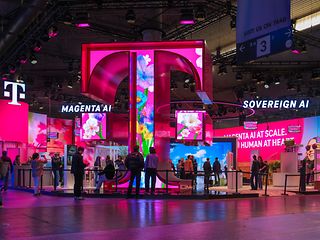
Experience our products and services live. From March 2 to 5, 2026, you will find Deutsche Telekom in hall 3 at booth 3M31. We look forward to seeing you. All events will be streamed live. Stage program and events: mwc.telekom.com/2026
About Deutsche Telekom: Deutsche Telekom at a glance