People around the world are accessing the internet with mobile devices. The number of connected devices is soaring. Soon machines will be communicating with each other in the Internet of Things. To progress the development of the digital society and make the Internet of Things working, we need a powerful wireless network that can transfer large volumes of data fast.
How fast is 5G?
5G improves the mobile internet. For a long time LTE was the fastest mobile technology available, supporting peak data rates of up to 300 megabits per second (Mbit/s). Even after the introduction of 5G LTE is still available for consumers.
Speed is the benchmark for wireless network performance. Also known as bandwidth, data transfer rate, data rate, or connection speed, it refers to the amount of digital data exchanged between two devices via a specific channel in a given period.
Network speed is generally measured in bits per second (bit/s). Bit stands for binary digit. With the larger volumes of data supported by 5G speeds, data transfer rates are expressed in kilobits (kbit/s), megabits (Mbit/s), and, in future, even gigabits (Gbit/s) or terabits (Tbit/s).
Just how fast 10 Gbit/s really is can be demonstrated by a simple example. A user takes around 13 minutes to download the content of a DVD (4.7 GB) over a DSL line with a bandwidth of 50 Mbit/s. A 5G-enabled smartphone or laptop could download the content of an entire DVD over a mobile 5G data link in just four seconds in the best-case scenario.
5G technology involves more than just speed though. Availability and reliability are other decisive factors.
Low latency as the prerequisite for real-time severalapplications
The term latency refers to the specific period of time over which an individual user activity on one mobile device triggers a subsequent reaction, the ping, on another device.
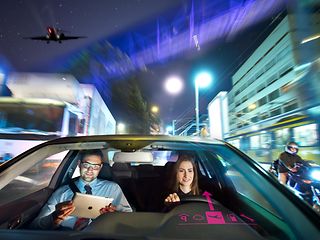
An example of the importance of a low-latency and high-performance 5G network is teleoperated driving: The Telekom network can ensure the transmission of large amounts of data in near real time from the vehicle to a remotely located control station. This enables vehicles to be reliably controlled from a distance.
The reaction time between the human eye and the brain is around ten milliseconds. With very low latencies real communication between connected machines and devices becomes feasible for the first time, for instance in Industry 4.0 or in medicine.
While virtual reality may be feasible with LTE, the potential of 5G and Edge Computing takes VR to a new, more impressive level.
Smart machines communicate in real time
The average latency in the LTE network is around 50 milliseconds. 5G improves latency and data rates substantially.. Researchers even set a record-breaking figure of one millisecond with tests in a laboratory environment. The aim is to guarantee the fast reaction times of 5G on a permanent basis.
Reliable latency and high data transfer rates are crucial in connecting smart devices in Industry 4.0. Here it is about guaranteed response times rather than one-time peak performance. In conjunction with artificial intelligence and edge computing, the faster data transmission with 5G will support reliable communication between machines and automated and autonomous production.
Connectivity based on 5G is becoming an important component in digitization of the industry. With the provision of virtual network slices, mobile robots can also be deployed flexibly and efficiently in economic production to meet specific requirements.
Data communication based on 5G speeds will play a key role in many use cases in future.