
Cutting-edge technology meets everyday life: Deutsche Telekom’s AI Phone puts a smart AI agent right to the smartphone’s home screen and enables easy voice control over apps: for restaurant reservations, booking taxis, playing music.
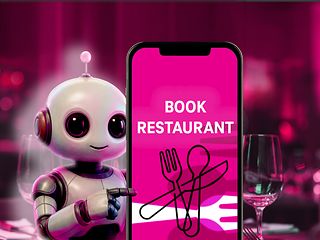
Deutsche Telekom’s AI Phone is one representative of an AI agent. Perplexity’s assistant turns it into an indispensable companion: for example, this virtual butler can book restaurant tables via voice command and add appointments directly to your calendar. It can also translate text instantly from photos. The assistant understands its surroundings, writes emails, makes phone calls, plays music, and summarizes texts. This makes Deutsche Telekom’s AI Phone a true everyday helper , offering a user-friendly interface to AI - at an unbeatable price. And it illustrates the principle of AI agents: AI agents are software programs that autonomously plan tasks, take actions, and make decisions using artificial intelligence to achieve specific goals—without constant human guidance.
How AI agents are transforming everyday life
Gartner forecasts that by 2028, AI agents will manage 20 percent of interactions in online stores. In the workplace, they will make 15 percent of routine decisions, says the market research firm, a significant increase from virtually zero percent in 2024. And by 2028, 33 percent of enterprise software will include agentic AI; compared to less than one percent in 2024.
What makes AI agents truly powerful? They respond almost instantly and can anticipate what comes next. They rely on Natural Language Understanding (NLU) for comprehending human language. Personalization is powered by generative AI, specifically large language models (LLMs). Their reasoning capabilities enable them to draw conclusions and make informed decisions. When necessary, AI agents access external tools and sources, such as documentation and real-time data. They collaborate seamlessly with other specialized AI agents as well as with humans. They monitor the outcomes of their actions and continuously optimize their approach. They operate within clearly defined guardrails and can, if necessary, limit their knowledge to specified sources.
Deutsche Telekom has been leveraging artificial intelligence for many years. The company relies on partnerships to bring the best AI solutions to market and focuses on co-development. The guiding principle: AI should solve business problems and boost productivity—while keeping human well-being at the core.
AI agents keep Deutsche Telekom’s network stable
Without a secure and stable network, even the most advanced AI applications won’t perform—including the AI Phone. That’s where Deutsche Telekom’s next innovative AI agent steps in: the “RAN Guardian Agent”. It monitors the radio access network (RAN) and assesses how well the local network can handle potential load increases. And it intervenes whenever necessary. Deutsche Telekom’s network is a complex system comprising antennas, servers, cables, distribution points, and various frequency bands. During major events like soccer matches or New Year’s Eve celebrations, cells can become congested as many users try to go online simultaneously. The challenge is to detect congested cells early and adjust radio performance to prevent service degradation: a job perfectly suited for the “RAN Guardian Agent”. It coordinates three specialized AI “colleagues”: the first analyzes public data sources and categorizes reported events. The second uses this information to evaluate network capacity, determine if neighboring antennas should assist, and monitors key parameters in real time. The third reallocates cellular resources or adjusts network configurations as needed. This results in fewer bottlenecks and more efficient usage. During quieter periods, the AI can even deactivate certain frequency bands to optimize efficiency. The “RAN Guardian Agent” is built on Gemini 2.0 and developed in collaboration with Google Cloud. In the long term, as Germany’s largest network operator, Deutsche Telekom aims to create “self-driving” autonomous networks, featuring automated control powered by data and AI.
Deutsche Telekom’s AI agents: a boost for business customers
In partnership with market leaders, Deutsche Telekom offers business customers AI-powered dialog systems. These so-called conversational AI systems answer thousands of inquiries across channels such as phone, website, or WhatsApp, simultaneously and in natural language. This provides companies with 24/7 availability and consistently friendly service—even for repetitive requests. For example, at a health insurance provider, an AI agent answers questions about the electronic patient record and identifies complex issues such as a defective health insurance card. When needed, it hands off to human staff. It also sends information directly to the user’s phone via a link.
Efficiency at the loading dock
The logistics AI agent digitizes delivery documents that would normally be processed manually. Through an app, truck drivers scan documents. The AI agent verifies completeness, legibility, address accuracy, and any required customs documents. At the same time, it transfers the data into the ERP operations planning system. Follow-up steps, such as payment upon full goods receipt, can then be automatically initiated. Behind the scenes, Deutsche Telekom’s SemaSuite® manages file ingestion. In addition, Telekom Business GPT is used as a large language model to understand, process, and generate human language. Using a graphical representation, a process designer breaks down the processes into understandable steps as a workflow diagram. This can be edited as so-called low code without in-depth IT knowledge. Deutsche Telekom’s API toolbox allows additional smart functions to be easily integrated. If a delivery is delayed, the AI agent automatically sends real-time SMS updates to recipients. The AI agent is thus a key component of end-to-end digital processes, boosting efficiency at the loading dock.
Understanding and adapting legacy software code
Deutsche Telekom uses the AI Engineer for software development both internally and in projects with business customers allowing to gain significant efficiency gains with code transformations, documentations and prototype development. This agent automatically generates, documents, and tests code, proficient in modern languages like Python and TypeScript as well as legacy ones such as COBOL and C++. For example for an app that issues temporary virtual car keys to friends and displays vehicle functions and status levels on a dashboard. Or a digital citizen services portal for applying for IDs and registering address changes. A simple prompt outlining the desired specifications is all it takes. Developers guide the AI Engineer, perform quality checks, and decide how to integrate the code into the customer’s existing IT infrastructure.
Form assistant for efficient applications
The Form Assistant is an AI-powered solution designed to simplify the often complex and confusing application processes of German authorities. By digitizing and structuring forms—such as asylum applications—it enables easier processing. The AI analyzes the form fields, identifies their types, and converts the logical structure into a digital format. It guides applicants through the form and provides clarification from a knowledge base whenever needed. Information from uploaded documents, like ID cards, is also integrated automatically. Users can interact in their preferred language, while the assistant automatically fills in the correct information. This solution demonstrates how AI can optimize administrative processes and help overcome barriers—especially for people with linguistic or physical impairments.
AI Foundation Services – the “marketplace” for secure AI
AI Foundation Services gives companies access to a broad range of open-source and proprietary AI models. The open-source models are operated by T-Systems in its own data centers with the highest security standards. The platform also offers a unified interface to Microsoft, Amazon, and Google clouds, as well as to language models hosted exclusively on these platforms. These LLM and AI models are essential for orchestrating AI agents that collect and process information from multiple sources to solve complex tasks.
Solving problems with AI agents
The ultimate responsibility for the use of AI remains with humans. In critical areas, AI should serve only a preparatory role despite automation, enabling people to make informed decisions and intervene when necessary. This balance of autonomous and supervised decisions is known as the human-in-the-loop principle.
By working hand in hand, artificial intelligence can unlock its positive potential and address real-world problems. Deutsche Telekom aims to lead in the use and provision of AI to benefit society, the economy, and the company—guided by ethical principles for responsible AI and green AI standards for sustainable development and technology use.
More information:
Media information: “Our” AI-phone brings „AI for everyone“
Media information: Agentic AI for Autonomous Networks
Blog: AI on the phone
Easy and simple: AI agents
AI Foundation Services
Shape, take, make – AI at Deutsche Telekom